

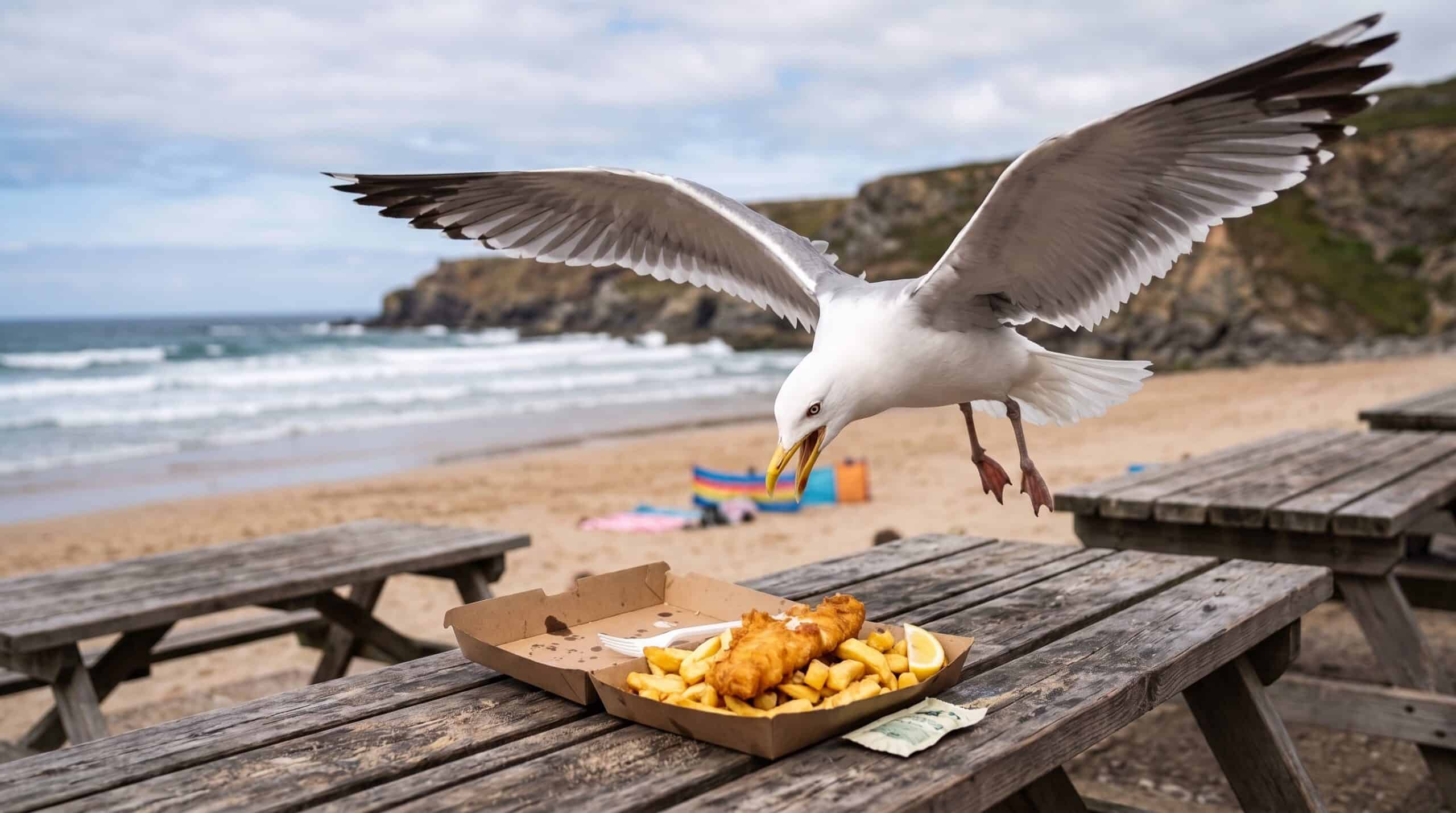
You are sitting on a beach, enjoying a sandwich or a box of fries, when a seagull suddenly swoops down and tries to take it. If this has happened to you, you are not imagining it. Gulls have become remarkably good at taking advantage of people who are eating outdoors. They watch what humans are doing, recognize opportunities to find food, and sometimes approach when they think the reward is worth the risk.
The good news is that you can make yourself a much less attractive target. Keeping food covered, paying attention to nearby gulls, and looking directly at an approaching bird can all reduce the chance of a successful food theft. Research has even found that gulls can respond to the way humans speak to them.
Why Seagulls Steal Human Food
Food stealing is not simply random aggression. Urban gulls have learned that people can be an easy source of food. Research in coastal towns has found that food stealing becomes more common when more human food is available. The researchers described stealing as a potentially low-risk, high-reward feeding strategy for gulls.
Gulls are also surprisingly good at paying attention to what humans are doing. Studies on European herring gulls found that they notice when people are handling food and can use human behavior as a clue when deciding what to investigate.
This helps explain why a gull may appear to be ignoring you until you unwrap a sandwich or open a bag of chips. The bird may already be watching what you are doing.
Keep Your Food Out of Sight
One of the simplest ways to reduce the chance of being robbed is to avoid displaying your food unnecessarily.
If you are eating outdoors, keep food inside a closed container, paper bag, or other cover until you are ready to eat it. Do not leave food sitting openly beside you while you are distracted.
This matters because gulls use human food-related cues when foraging. Experiments have shown that herring gulls are particularly interested in objects that have been handled by people when those objects are associated with food.
For example, if you are sitting on a beach with an open box of fries, a gull has an obvious visual target. Keeping the box closed until you are actually eating makes the food less exposed.
Watch the Seagulls Around You
Do not wait until a gull is already beside your food.
If you notice gulls watching you closely, especially if one is facing you and repeatedly moving closer, pay attention to it. Move your food closer to your body or cover it before the bird gets within striking distance.
Research has found that herring gulls pay increased attention to people when those people are associated with food. Their head movements, body orientation and approaches toward humans all increased in food-related situations.
A gull that is watching you is not necessarily going to attack or steal your food. In one experiment, only 26% of targeted herring gulls actually approached and touched the food. This suggests that only some individuals steal food, rather than it being an inevitable behavior among all gulls.
Make Eye Contact With Them
If a gull is approaching your food, look directly at it.
This is more than just common advice. Researchers have tested whether herring gulls respond to human gaze.
In an experiment published in Biology Letters, researchers placed food near a person and compared gulls’ behavior when the person looked directly at them with their behavior when the person looked away. Gulls took significantly longer to approach when the person was looking at them.
The effect was not identical in every bird, so eye contact is not a guaranteed solution. Some gulls were much less affected by the person’s gaze than others. Still, it is a simple and harmless response worth using when a gull starts approaching.
Instead of looking down at your food, look at the bird and keep your attention on it.
Use Your Voice to Scare
If the bird keeps approaching, use your voice.
Newer research provides some interesting evidence that the way you speak may matter. In a 2025 experiment, researchers tested 61 wild herring gulls in nine coastal towns in Cornwall. They played recordings of a man shouting, the same man speaking normally, and a neutral robin song while the gulls approached human food.
The gulls reacted to both human voices by becoming more cautious and spending less time around the food. However, the shouting voice produced a stronger response. Nearly half of the gulls exposed to the shouting flew away within a minute, compared with about 15% exposed to the normal speaking voice.
This does not mean you should scream at every gull you see. But if one is actively approaching your food, a firm and loud “No! Stay away!” may work better than quietly asking it to leave.
The study also found that the birds responded to the manner of the voice, not simply its volume. The recordings were played at the same volume, yet the gulls reacted differently to shouting and normal speech.
Do Not Chase or Attack Seagulls
There is an important difference between deterring a gull and chasing it.
If a gull approaches, you can stand up, face it, and make yourself clearly aware of its presence. But do not try to hit it, grab it, kick it, or chase it aggressively.
Physical attacks can injure the bird and may create a dangerous situation for you, particularly if other gulls are nearby. During nesting season, gulls can also become more defensive around their nests and young.
A simple combination of eye contact, movement toward the bird and a firm voice is a much safer approach.
Never Feed Them
If you regularly feed gulls, you can unintentionally teach them that approaching people produces food.
Feeding also makes gulls more comfortable around humans and can contribute to nuisance behavior in places where people eat outdoors. Wildlife management guidance recommends reducing access to food and discouraging deliberate feeding as part of long-term gull management.
The same principle applies to accidentally leaving food behind. If you finish eating at the beach or in a park, put leftovers into a properly closed bin rather than leaving them on the ground. Open rubbish and food waste can attract gulls and encourage them to spend more time around people.
Avoid Eating Around Hungry Seagulls
Location matters too. If dozens of gulls are already gathered around people, food stalls or rubbish bins, eating there gives the birds many opportunities to investigate your food.
If possible, move to a less crowded area. Choose a place where gulls are not already actively feeding and keep your food covered when you are not eating.
This approach works because the larger problem is not simply the bird itself. It is the food opportunity. Wildlife management research consistently finds that removing or securing food sources is one of the most important long-term ways to reduce gull conflicts.
Do Eye Markings Actually Work?
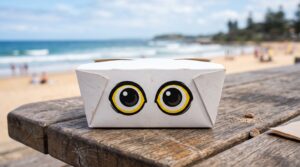
You may have seen food boxes or deterrent devices with large artificial eyes printed on them. There is now some scientific evidence behind this idea, although it should not be treated as a guaranteed solution.
A 2026 study tested takeaway food boxes with eye-like markings against plain boxes. Some gulls were slower to approach the boxes with the markings and were less likely to peck them. However, the response varied greatly between individual birds. About half of the tested gulls consistently avoided the eye-marked boxes, while others showed little or no avoidance.
This means eye-like designs may have potential as one part of a deterrent strategy, but they are not a magic solution for every gull.
What If a Gull Takes Your Food
If a gull has already taken your food, it is usually best to let it go.
Do not try to wrestle the food away from the bird. Gulls have sharp bills and can react unpredictably when someone attempts to take food from them.
More importantly, fighting over a sandwich is not worth getting injured.
If the bird drops the food, do not eat it. Dispose of it and wash your hands if you handled anything contaminated by the bird.
The Most Effective Approach
There is no single method that works on every gull. Individual birds behave differently, and gulls can become accustomed to repeated deterrents. Wildlife management guidance therefore recommends combining several methods rather than relying on one technique alone.
For someone eating outdoors, a practical approach is:
- Keep your food covered until you are ready to eat.
- Watch gulls that are paying close attention to you.
- Keep the food close to your body rather than holding it out openly.
- Look directly at an approaching gull.
- Stand up or move toward it if it continues approaching.
- Use a firm voice, and if necessary, shout to make it back away.
- Never deliberately feed gulls.
- Put leftovers and rubbish into closed bins.
The research suggests that gulls are not simply mindless birds that see food and immediately attack. They watch humans, respond to our behavior and make decisions based on the risks and rewards involved. That is why changing your own behavior can make your food a less attractive target.
