

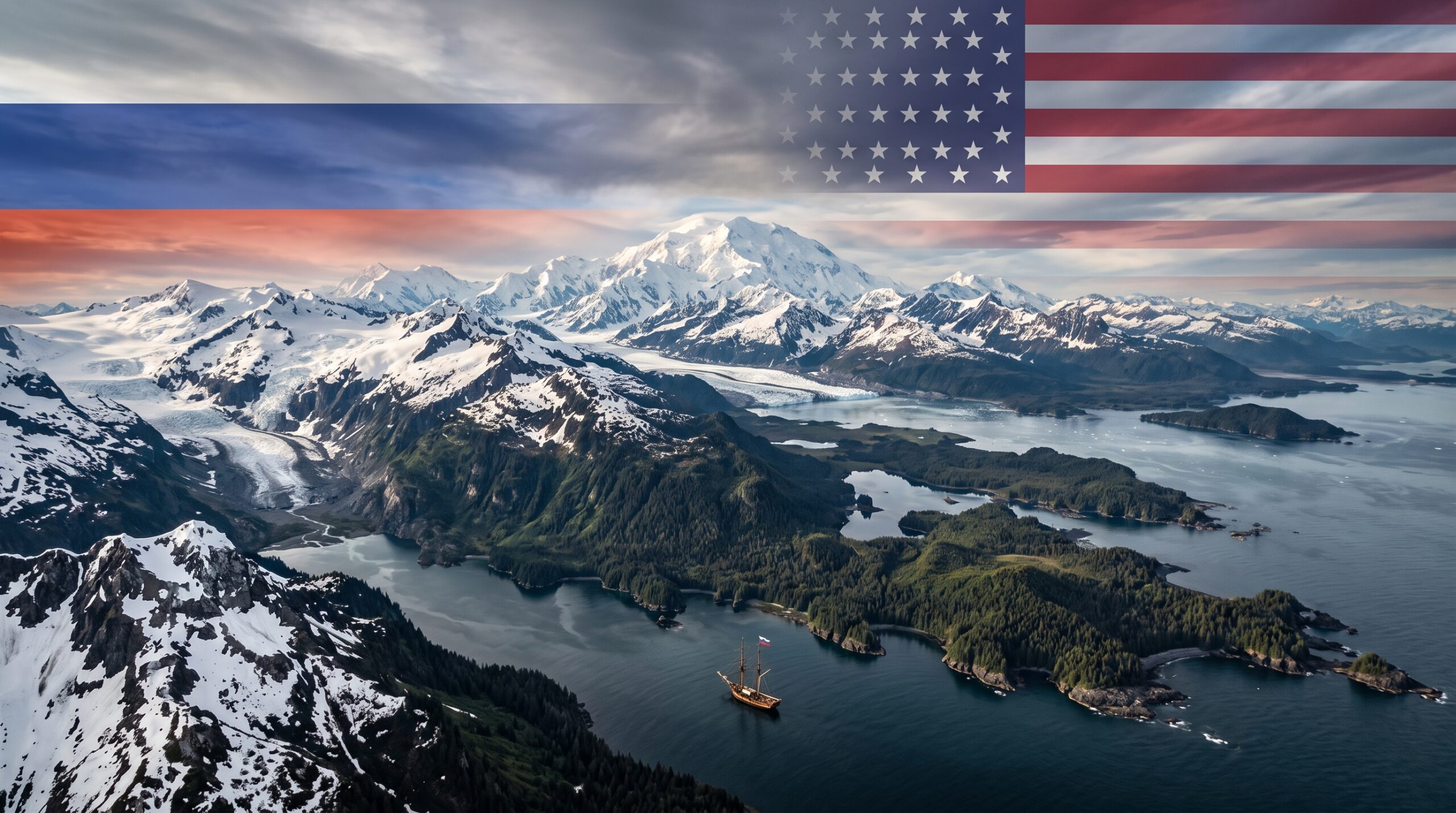
Today, Alaska is the largest state in the United States, but it was once controlled by Russia. The story of how it became American territory is not a story of war between the two countries. Instead, Alaska changed hands through a diplomatic agreement and a payment of $7.2 million.
The deal was completed in 1867, when the United States purchased the territory from the Russian Empire. But the reasons behind the sale, the negotiations, and what happened afterward make the story more interesting than the simple phrase “America bought Alaska” suggests.
Russia Arrives In Alaska
Russia’s connection with Alaska began in the 18th century. Russian explorers moved eastward across Siberia and eventually reached the North American coast. In 1741, the expedition led by Vitus Bering reached the Alaskan region, opening the way for further Russian exploration and trade.
Russian traders became particularly interested in Alaska because of its valuable fur resources. The Russian-American Company was established in 1799 and received extensive control over Russia’s activities in the region. Russian settlements and trading posts followed, although the Russian population in Alaska remained small.
Russia’s control was also difficult to maintain. Alaska was thousands of miles from the Russian heartland, and supplying settlements there was expensive. According to the U.S. State Department, permanent Russian settlers in Alaska never numbered more than about 400.
At the same time, Russia had another problem. Alaska was close to British territory in North America, and Russia feared that it could lose the region in a future conflict with Britain.
Why Russia Wanted To Sell
Russia’s interest in selling Alaska developed before the American Civil War. Russian officials understood that defending such a distant territory would be difficult, especially during a major war.
The Crimean War of 1853–1856 strengthened these concerns. Russia had fought Britain, France, the Ottoman Empire and Sardinia-Piedmont, and the possibility of another conflict with Britain made Alaska look increasingly vulnerable.
Russia also needed money. Maintaining its North American possessions was expensive, while the territory was producing less economic benefit than it once had. Russian officials therefore began considering a sale to the United States.
There was also a strategic reason. Russia and Britain were competing for influence in the Pacific and North America. Selling Alaska to the United States could prevent Britain from eventually taking the territory.
Russia had actually offered Alaska to the United States before, but the timing was poor. The American Civil War delayed serious negotiations.
The United States Was Interested
The United States had its own reasons for wanting Alaska.
During the 19th century, American leaders were increasingly interested in expanding U.S. territory and commercial influence toward the Pacific. William H. Seward, who served as Secretary of State under Presidents Abraham Lincoln and Andrew Johnson, strongly supported expansion and saw Alaska as strategically useful.
Seward believed that American interests would eventually extend across the Pacific. Alaska’s position gave the United States access to the northern Pacific and brought American territory much closer to Asia.
After the Civil War ended in 1865, negotiations with Russia became serious again.
In December 1866, Russian diplomat Eduard de Stoeckl met Tsar Alexander II and received instructions to pursue a sale. He returned to Washington and began negotiating with Seward.
The Night Alaska Was Purchased
The negotiations moved surprisingly quickly.
On March 30, 1867, Seward and Stoeckl reached an agreement. The United States would pay Russia $7.2 million in gold for its North American territory.
The treaty transferred nearly 600,000 square miles of territory to the United States. The price worked out to less than two cents per acre.
The treaty still required approval from the U.S. Senate. The Senate approved it on April 9, 1867, and President Andrew Johnson formally ratified it on May 28. The two governments exchanged their ratifications on June 20.
The United States had therefore legally acquired Alaska through a treaty rather than by conquering it.
The Transfer Took Place In Sitka
Although the treaty had been agreed upon months earlier, the physical transfer of the territory came later.
On October 18, 1867, American and Russian representatives gathered in Sitka, the main Russian settlement in Alaska, for the official transfer ceremony.
The Russian flag was lowered and the American flag was raised. Russian troops began leaving, while American forces took possession of the territory.
There was even a small problem during the ceremony. The Russian flag became stuck while being lowered, requiring soldiers to deal with it before the ceremony could continue.
October 18 is now remembered in Alaska as Alaska Day.
Interestingly, the United States had not yet actually sent Russia the $7.2 million when the physical transfer took place. Congress later approved the money, and the Treasury issued the payment in 1868. The surviving cancelled check shows the $7.2 million payment to the Russian government.
Why People Mocked The Purchase
Not everyone in the United States thought buying Alaska was a good idea.
Some Americans considered the territory remote, cold and economically unimportant. Critics mocked the purchase with names such as “Seward’s Folly” and “Seward’s Icebox.”
At the time, many people could not see what the United States would gain from such a huge and distant territory.
That opinion changed as Alaska’s natural resources became more apparent.
Gold discoveries in and around Alaska and the Yukon brought thousands of people north during the late 19th-century gold rushes. The Klondike Gold Rush, which began in the 1890s, helped demonstrate the economic value of the region.
Later discoveries of oil, minerals and other resources made Alaska even more important to the United States.
Alaska Was Not Immediately A State
Buying Alaska did not make it a U.S. state.
For decades after the purchase, the federal government gave Alaska limited attention. Different parts of the U.S. government administered the territory, and Alaska did not immediately receive the same political status as established American states.
A civil government was established in 1884, but Alaska remained a U.S. territory for many years.
The situation eventually changed as Alaska’s population and political importance grew. After decades of campaigning for greater self-government, Congress approved statehood.
On January 3, 1959, Alaska officially became the 49th state of the United States.
What Happened To Alaska’s Native Peoples?
The Alaska Purchase did not mean that the land was previously empty.
Indigenous peoples had lived throughout Alaska for thousands of years before Russian explorers arrived. They included many distinct peoples and communities, including Iñupiat, Yup’ik, Unangan, Alutiiq, Dena’ina, Tlingit, Haida and others.
The 1867 treaty primarily dealt with the transfer of Russia’s territorial claims and possessions to the United States. It also contained provisions concerning inhabitants of the territory. However, Alaska Native peoples subsequently faced major changes under American rule, including government policies affecting land, education, resources and political rights.
This is an important part of the story because the Alaska Purchase was an agreement between the Russian and American governments, but the territory already had established Indigenous societies and communities.
