

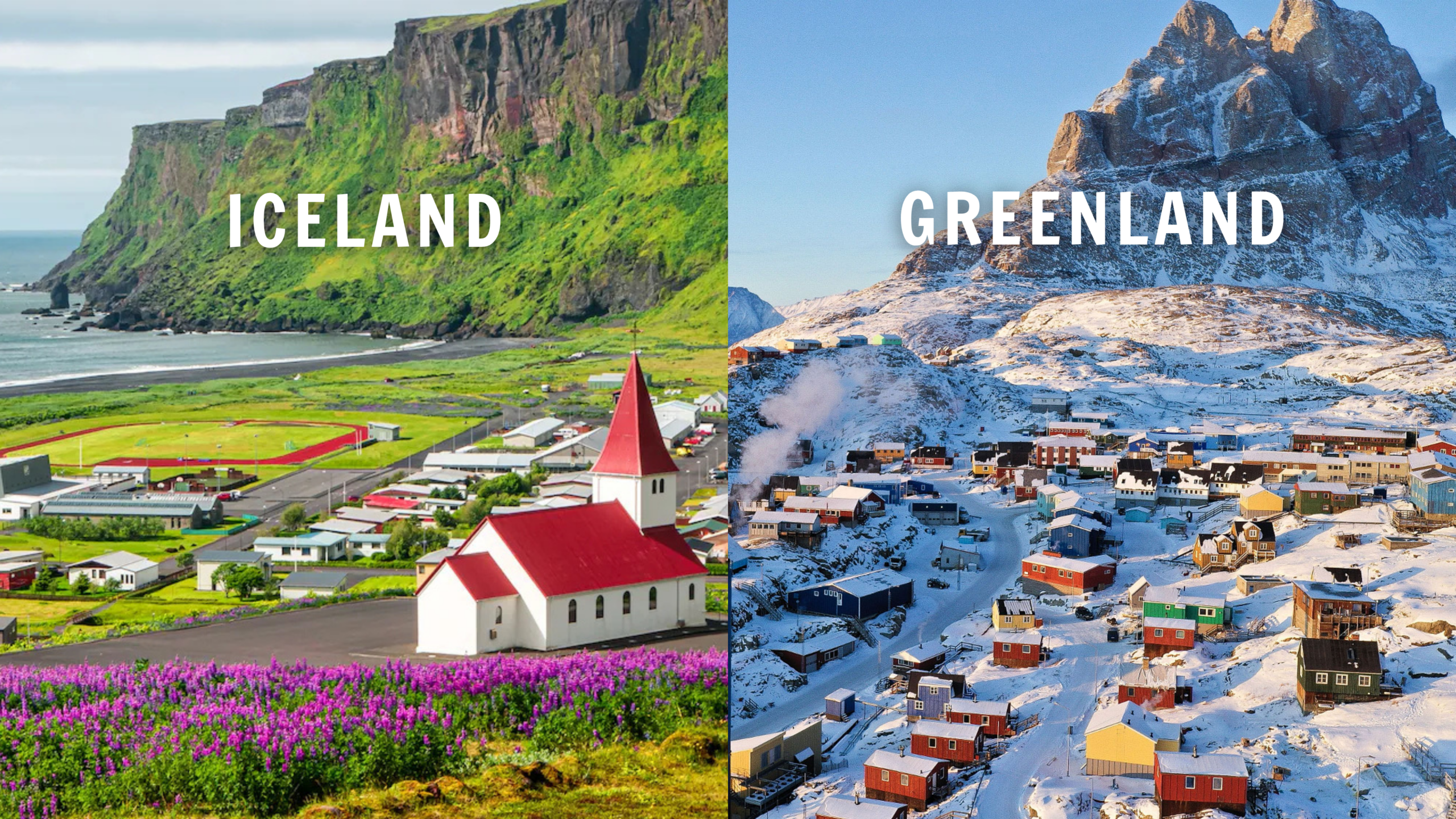
Iceland and Greenland seem to have completely opposite names. Iceland is known for its green valleys, grassy fields and moss-covered landscapes, while around 80 percent of Greenland is buried under a massive ice sheet. So, did the Vikings simply get the names wrong?
There is a popular story that the Vikings intentionally switched the names to mislead people, making the icy land sound attractive and the greener one sound dangerous. It is an interesting explanation, but the real story is more complicated. The names came from two different Viking explorers, different circumstances and, in Greenland’s case, perhaps a little bit of clever marketing.
The story becomes even more interesting because Greenland was somewhat greener around 1,000 years ago, when Norse settlers arrived. At the same time, Iceland has always had glaciers and large areas of snow and ice. The names simply stayed the same as the climate and landscapes changed.
How Iceland Got Its Name
Iceland’s name dates back to the Viking Age. According to the medieval Landnámabók, a Norwegian sailor named Naddodd reached the island after being blown off course. He reportedly called it Snæland, meaning “Snow Land.” Another explorer, Garðar Svavarsson, later called it Garðar’s Island.
The name Iceland eventually came from another Viking explorer named Hrafna-Flóki Vilgerðarson, commonly known as Raven-Flóki. The story says that Flóki spent a difficult winter in Iceland. When he climbed a mountain and saw a fjord filled with ice, he called the island Ísland, meaning “Ice Land.”
Flóki was not trying to describe every part of the island. He was simply naming it based on what he experienced. That name eventually became the one that survived.
How Greenland Got Its Name
Greenland has a completely different naming story. Around 982, the Norse explorer Erik the Red was exiled from Iceland. He sailed west and explored Greenland’s coast before returning to Iceland several years later.
When Erik returned, he wanted people to join him in settling the new land. The Saga of Erik the Red says he called the country Greenland because he believed that a pleasant name would encourage people to move there.
This may sound like false advertising, but there was some truth behind the name. The Norse settlers mainly lived in southwestern Greenland, where they found ice-free coastal areas with grass that could support farms and livestock. Greenland’s interior was, and remains, dominated by a huge ice sheet.
Greenland Was Green During Viking Age
Greenland was not a warm or forest-covered paradise when the Vikings arrived. However, its southern coastal areas were suitable enough for farming during a relatively favorable period of climate conditions. Norse settlers raised animals and established farms around the fjords of southern Greenland.
Scientists have found evidence that conditions in parts of Greenland were relatively mild during the period when the Norse settlements existed. However, researchers do not believe climate alone explains why those settlements eventually disappeared. Cooling conditions, increasing sea ice, economic problems and other social factors may all have played a role.
Why Iceland Looks So Green
Iceland can look surprisingly green today, especially during summer.
Its climate is strongly influenced by the North Atlantic Ocean. Relatively warm ocean currents help keep Iceland’s coastal areas milder than its northern location might suggest. The island also receives plenty of precipitation, which supports grass, moss and other vegetation.
At the same time, Iceland is not entirely green. Glaciers cover roughly 11 percent of the country, and Iceland also has volcanic deserts, mountains and snowfields.
Greenland Is Not Completely Frozen
Greenland is also more than just ice. About 80 percent of Greenland is covered by the Greenland Ice Sheet, one of the largest bodies of ice on Earth. In some places, the ice is more than three kilometers thick.
However, the coastline contains large areas without permanent ice. Most Greenlandic communities are located along the coast, where people live among rocky mountains, fjords and areas of vegetation.
Southern Greenland can become quite green during summer. Grass grows there, and some farming is possible. So, the name Greenland is not completely unreasonable. It simply becomes misleading when we imagine the whole island as green.
Did Vikings Switch the Names?
There is no evidence that Vikings switched the names of Iceland and Greenland to confuse people. Iceland already had its name before Greenland was named. Hrafna-Flóki’s encounter with ice inspired Iceland’s name, while Erik the Red later chose Greenland partly to attract settlers.
The names came from different situations and stayed the same for more than 1,000 years. Iceland has glaciers but also large green areas, while Greenland has green coastal regions but remains mostly covered by ice.
So, the Vikings did not get the names backward. They named the two places based on what they saw, experienced and, in Greenland’s case, what they wanted others to see.
