

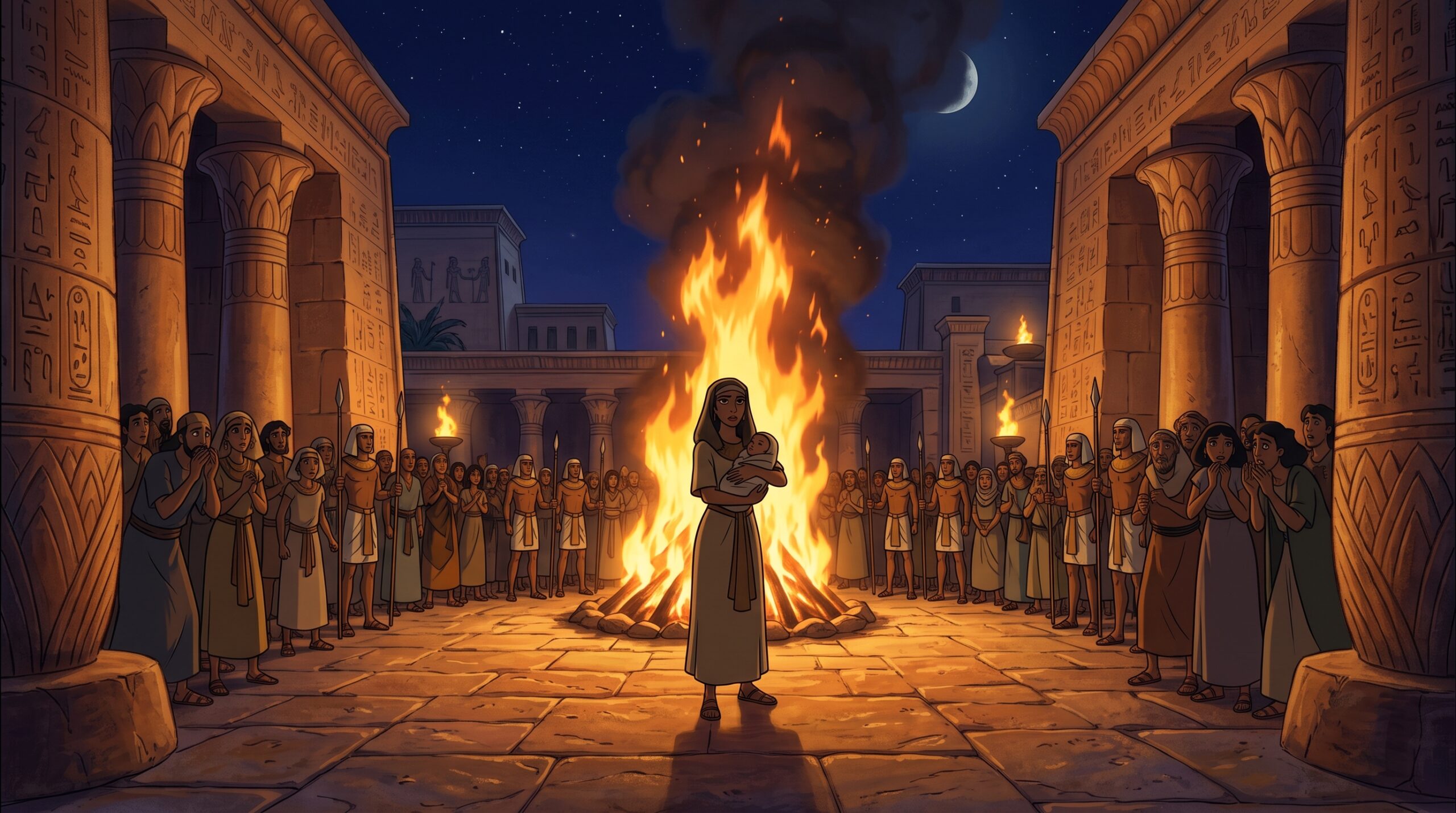
The woman was the hairdresser of Pharaoh’s daughter, and her story is one of the well-known examples of steadfast faith in Islamic tradition. A Hadith narrated from Ibn Abbas tells how she remained firm in her belief in Allah even when Pharaoh threatened her and her children. The story is connected with the Prophet Muhammad’s ﷺ Night Journey and is recorded in Musnad Ahmad.
One important point is often missed when this story is told. The woman who was thrown into the fire was not Pharaoh’s wife, Asiyah. They were two different women.
The Qur’an specifically mentions Pharaoh’s wife as an example for believers. She prayed, “My Lord, build for me near You a house in Paradise, and save me from Pharaoh and his deeds.” – Surah At-Tahrim (66:11). Islamic commentators commonly identify her as Asiyah bint Muzahim, although her name is not given in the Qur’anic verse itself.
The woman in the fire was a servant who worked as the hairdresser of Pharaoh’s daughter. Her personal name is not established in the Hadith itself. The name “Māshita,” often used in popular accounts, comes from later Islamic writings and means a female hairdresser or one who combs hair.
How Pharaoh Discovered Her Faith
The story begins during the Night Journey of Prophet Muhammad ﷺ. He reportedly smelled a beautiful fragrance and asked the angel Jibril about it. Jibril told him that it was the fragrance of the hairdresser of Pharaoh’s daughter and her children.
The Hadith then explains what had happened to them.
While the woman was combing Pharaoh’s daughter’s hair, her comb accidentally fell from her hand. As she picked it up, she said “Bismillah”, meaning “In the name of Allah.” Pharaoh’s daughter asked whether she meant her father.
The woman answered that Allah was her Lord, as well as the Lord of Pharaoh. When Pharaoh’s daughter reported this to him, Pharaoh summoned the woman and questioned her directly. She did not change her answer. She continued to affirm that Allah was her Lord.
Her statement was especially dangerous because Pharaoh demanded submission to his authority. The Qur’an describes him claiming, “I am your lord, most high,” Surah An-Nazi’at (79:24) and elsewhere records him saying that he knew of no god for his people other than himself. Surah Al-Qasas (28:38).
Pharaoh Ordered Her Children into Fire
Pharaoh then ordered that a large copper vessel be heated. He commanded that the woman and her children be thrown into it.
Before her punishment began, she made one request. She asked Pharaoh to gather her bones and the bones of her children together and bury them in the same place. The narration says that Pharaoh agreed to this request.
Her children were then thrown into the fire one after another while she watched.
The final child was still an infant. At that moment, the mother hesitated because of her baby. The Hadith says that the infant spoke and encouraged his mother to remain firm, telling her that the punishment of this world was easier than the punishment of the Hereafter. She then entered the fire with her child.
This detail is one of the most extraordinary parts of the narration. Ibn Abbas also mentioned the hairdresser’s child among a small number of infants who spoke miraculously while still very young.
How Reliable Is This Story?
It is narrated through the Hadith tradition and appears in Musnad Ahmad, as well as collections including Ibn Hibban and al-Hakim.
The version recorded in Musnad Ahmad is commonly identified as Hadith 2821. Modern Hadith grading cited for this narration describes its chain as hasan, meaning good or acceptable. Scholars including Ahmad Shakir and Shu’ayb al-Arna’ut gave favorable assessments of its chain.
What the Qur’an Says About Pharaoh
Although the hairdresser’s story comes from Hadith rather than the Qur’an, the Qur’an gives important background about Pharaoh’s behavior.
Pharaoh presented himself as an ultimate authority and challenged the message brought by Prophet Musa. The Qur’an records him saying that he knew of no god for the people other than himself. It also describes him proclaiming himself their “most exalted lord.”
The Qur’an therefore presents Pharaoh as a ruler who went far beyond ordinary political authority. His rejection of Allah and persecution of believers form a major part of the story of Musa and the Israelites.
This helps explain why the hairdresser’s simple statement that Allah was her Lord represented such a serious challenge to Pharaoh’s authority.
Hadith 2821, Musnad Ahmad
The Messenger of Allah ﷺ said: On the night I was taken on the Night Journey, a pleasing scent came to me, and I asked, “O Gabriel, what is this pleasant fragrance?” He replied, “This is the scent of the hairdresser of Pharaoh’s daughter and her children.” I asked, “What is their story?” Gabriel explained: “As she was combing the hair of Pharaoh’s daughter one day, the comb fell from her hand, and she said, ‘In the name of Allah.’ Pharaoh’s daughter asked her, ‘My father?’ She replied, ‘No, my Lord and your father’s Lord is Allah.’ The daughter said, ‘Shall I tell him that?’ The hairdresser said, ‘Yes.’ She informed Pharaoh, who summoned her and asked, ‘Do you have a lord other than me?’ She replied, ‘Yes, my Lord and your Lord is Allah.’ So Pharaoh ordered a copper cow to be heated, and he commanded that she and her children be thrown into it. She said to him, ‘I have a request of you.’ He asked, ‘What is your request?’ She said, ‘I would like you to gather my bones and my children’s bones into one cloth and bury us together.’ He replied, ‘That is your right upon us.’ He then ordered that her children be thrown into the fire one by one before her, until they reached a nursing infant. It was as if she hesitated on account of him, and the child said, ‘O mother, plunge in, for the torment of this world is lighter than the torment of the Hereafter.’ So she plunged in.”
