

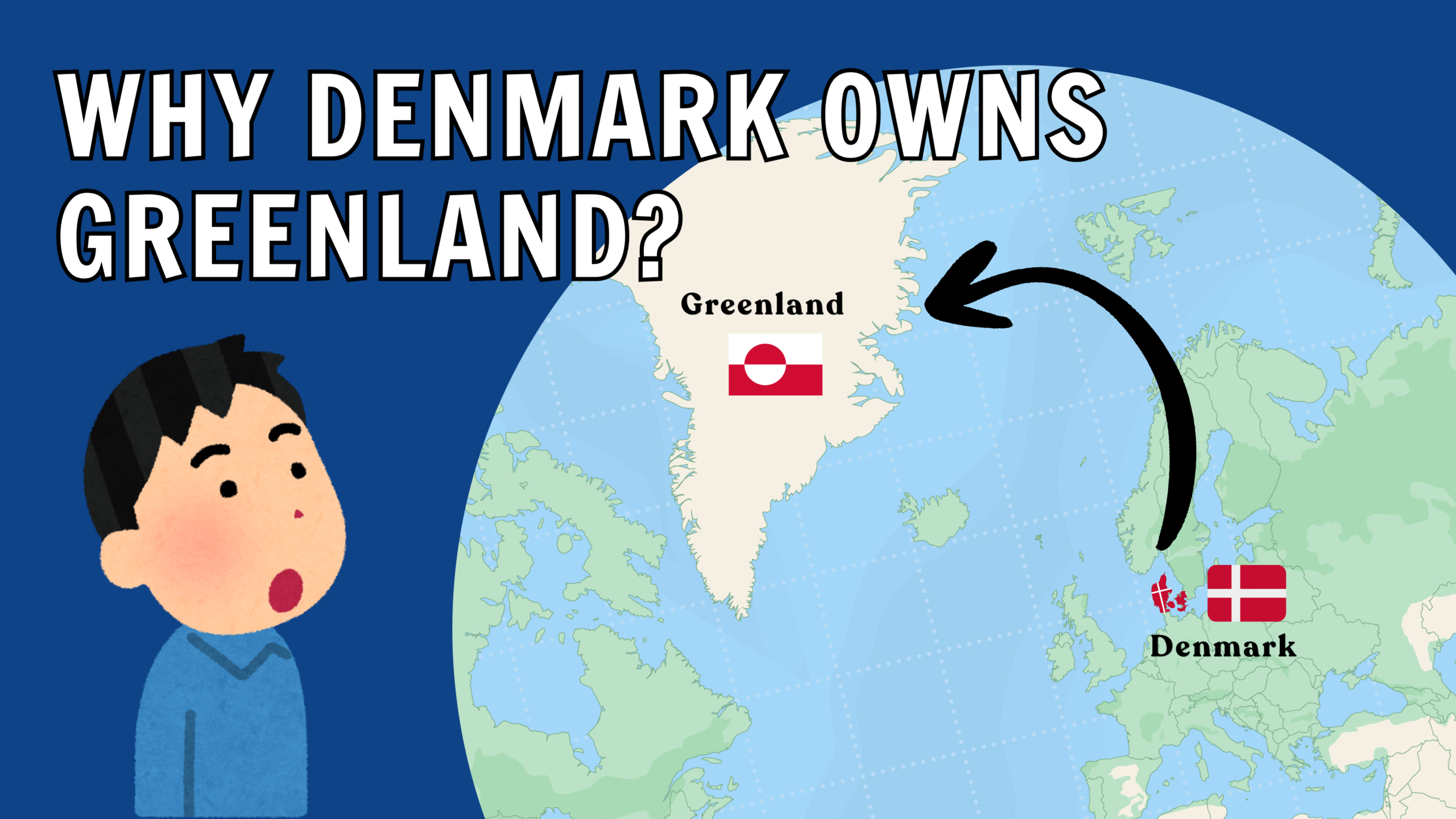
Greenland is geographically much closer to Canada than Denmark, so its connection to a European country can seem strange. The island is more than 3,000 kilometers from Denmark, while parts of Greenland lie only a few hundred kilometers from the Canadian Arctic. Yet today Greenland remains part of the Danish Realm, with its own parliament and government.
The story goes back more than 1,000 years and involves Vikings, the Norwegian kingdom, Danish rule, colonialism and eventually Greenland’s growing demand for self-government. Greenland did not simply become Danish because Denmark discovered and conquered the island. Its political status developed through a much more complicated chain of events.
The Vikings Arrived in Greenland
Long before Denmark controlled Greenland, Norse settlers arrived from Iceland.
Erik the Red established a Norse settlement in Greenland around the end of the 10th century. Other Norse communities followed, particularly around the southwestern fjords, where the climate allowed them to keep livestock and farm.
These settlers were closely connected to Iceland and Norway. Greenland’s Norse settlements eventually became part of the wider Norwegian political world, even though the island was extremely far from mainland Europe.
By the 13th century, Greenland had accepted the authority of the Norwegian king. This did not mean that Norway controlled every part of the island. The Norse settlements were small and isolated, but they recognized the Norwegian crown and became part of the Norwegian kingdom.
Greenland Became Linked to Denmark
The important change came through the complicated history of the Scandinavian kingdoms.
In 1397, Denmark, Norway and Sweden were brought together under the Kalmar Union, a political union ruled by the Danish monarch Margaret I. Greenland was already associated with Norway, so it effectively became part of the territories connected to the Danish monarchy through this union.
Sweden eventually left the union, but Denmark and Norway remained closely connected.
From 1536, Denmark and Norway were effectively governed as one kingdom under the Danish crown. Greenland therefore remained associated with the Danish-Norwegian monarchy, even though direct European activity in Greenland had declined significantly.
This distinction is important. Greenland did not originally become Danish as an independent territory. It was connected to Norway first and later came under the Danish crown because Denmark and Norway became politically united.
Denmark Returned to Greenland
For centuries, European contact with Greenland was limited. The old Norse settlements had disappeared by the 15th century, but Greenland was not forgotten by European powers.
In the early 18th century, Denmark-Norway became more actively involved. In 1721, the Norwegian missionary Hans Egede arrived in Greenland with support from the Danish-Norwegian king. His mission eventually grew into a permanent Danish-Norwegian presence.
Danish trading posts and colonial settlements were established along Greenland’s western coast. Over time, Denmark strengthened its control over the island, while the Greenlandic Inuit population remained the overwhelming majority of the local population.
This period is important because it marks the beginning of modern Danish colonial rule in Greenland.
Why Greenland Stayed With Denmark
The biggest turning point came in 1814.
During the Napoleonic Wars, Denmark and Norway were on the losing side. Denmark was forced to give Norway to Sweden through the Treaty of Kiel in January 1814.
You might therefore expect Greenland to have gone to Sweden along with Norway.
It did not.
The treaty separated Norway from the territories that had been connected to the Danish-Norwegian monarchy. Greenland, along with Iceland and the Faroe Islands, remained with Denmark. A scholarly history of the treaty describes this as a surprising outcome because these North Atlantic territories had historically been associated with Norway.
From this point, Greenland’s connection to Denmark became much clearer. Norway was transferred to Sweden, but Greenland stayed with Denmark.
Greenland Became a Danish Colony
During the 19th and early 20th centuries, Denmark continued to govern Greenland as a colony.
Danish authorities controlled trade, administration and much of Greenland’s contact with the outside world. The system was designed partly to protect Greenlandic society from outside economic influence, but it also gave Denmark considerable control over Greenland’s economy and political affairs.
Greenland remained very different from Denmark itself. Its population was overwhelmingly Greenlandic Inuit, and traditional hunting remained central to life in many communities.
That began to change rapidly during the 20th century.
From Colony to Self-Government
A major change came in 1953, when Greenland stopped officially being a Danish colony and became a part of the Danish Kingdom under the Danish Constitution.
However, becoming legally integrated into Denmark did not end the debate over Greenland’s political future.
Greenland received Home Rule in 1979, giving Greenlanders much greater control over their own domestic affairs.
The next major step came in 2009. Greenland introduced its current Self-Government arrangement, following a referendum in 2008 in which about 75 percent of participating voters supported greater self-government.
Today, Greenland has its own elected parliament, called Inatsisartut, and its own government, Naalakkersuisut. Greenlandic is also recognized as the official language.
So Who Controls Greenland Today?
Greenland is still part of the Kingdom of Denmark, but Denmark does not directly control everything in Greenland.
The Greenlandic government manages many domestic matters, while Denmark retains responsibility for areas such as foreign policy, defense and some other matters that have not been transferred to Greenland. Greenland also elects two representatives to Denmark’s parliament.
The current arrangement also recognizes that the people of Greenland have a right to self-determination. The Self Government Act provides a legal path toward Greenland potentially becoming independent if Greenlanders choose that future and the necessary process is completed.
So Greenland’s relationship with Denmark is not simply a story of one country taking another country’s territory.
Today, Greenland remains within the Danish Realm, but it has a level of self-government that would have been difficult to imagine during the colonial period. Its political future ultimately depends heavily on the people of Greenland themselves.
