

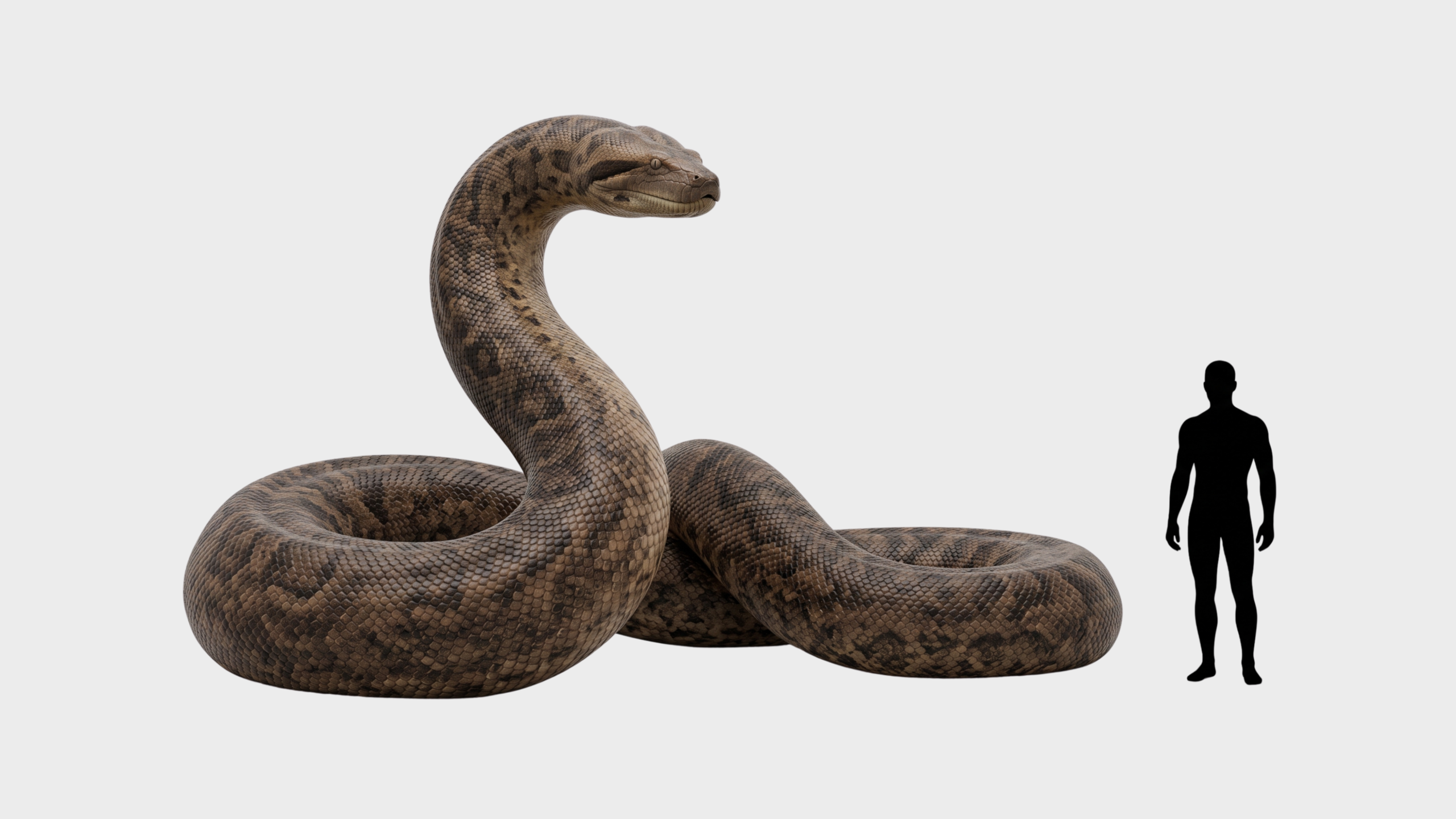
Titanoboa was one of the largest snakes known to science, reaching an estimated 13 meters, or about 42 feet, in length and weighing roughly 1,135 kilograms. It lived around 58 to 60 million years ago in what is now northern Colombia, only a few million years after the dinosaurs disappeared. Fossils show that this enormous snake belonged to the boid group, which includes modern boas and anacondas.
Its scientific name, Titanoboa cerrejonensis, means roughly “titanic boa from Cerrejón,” referring to the place where its fossils were discovered. Despite popular images of Titanoboa as a giant land snake, researchers believe it probably spent much of its time in or around water, somewhat like a modern anaconda.
When Titanoboa Lived
Titanoboa lived during the Paleocene Epoch, shortly after the mass extinction that ended the age of non-avian dinosaurs. Earth was considerably warmer than today, while tropical forests were already developing across parts of South America.
Its fossils came from the Cerrejón Formation in northeastern Colombia. The rocks preserve an ancient rainforest ecosystem containing plants, fish, turtles, crocodile relatives, and other animals that lived alongside the giant snake.
The first formal scientific description of Titanoboa appeared in Nature in 2009. Researchers identified 184 vertebrae and ribs representing 28 individual Titanoboas in the original study. [1]
How Big Was Titanoboa?
The most widely accepted scientific estimate puts Titanoboa at about 13 meters long and 1,135 kilograms. That is approximately the length of a school bus and more than five times the mass of a large adult human.
Some reconstructions have suggested lengths approaching 15 meters, or around 50 feet. However, scientists have not found a complete Titanoboa skeleton, so its exact maximum size remains uncertain. The 13-meter estimate is therefore a better scientific benchmark than the larger figures sometimes used in popular media.
Scientists estimated its size by studying its enormous vertebrae. They compared the dimensions of Titanoboa’s bones with the skeletons of living snakes and used established relationships between vertebral size and total body length to calculate its approximate dimensions.
What Did Titanoboa Eat?
Titanoboa was a carnivore, although scientists cannot determine its complete diet from the available fossils. Its enormous size would have allowed it to tackle prey that would be impossible for most modern snakes.
The Cerrejón ecosystem contained fish, turtles, and several crocodile relatives. One possible prey animal was Cerrejonisuchus improcerus, a crocodile relative that was around 6 to 7 feet long. Researchers consider it a plausible food source because the two animals lived in the same ecosystem and modern giant constrictors can prey on crocodilian animals.
Titanoboa may have hunted by ambushing animals near the water. Its exact hunting technique, however, remains uncertain. Comparisons with modern anacondas and boas can provide clues, but they cannot prove exactly how Titanoboa behaved.
Why Was Titanoboa So Large?
Temperature may have played an important role in Titanoboa’s enormous size. Snakes are ectothermic, meaning they rely heavily on their surroundings to regulate body temperature. Warmer environments can support higher levels of activity and, under suitable conditions, may allow reptiles to reach larger body sizes.
The original Titanoboa research estimated that its environment had a mean annual temperature of roughly 30 to 34 degrees Celsius. That would have made the Cerrejón rainforest substantially warmer than most tropical forests today.
This temperature estimate is not certain. Other researchers questioned whether body size alone could reliably determine ancient temperatures because factors besides climate can influence the size of extinct animals. The estimate remains an important scientific interpretation rather than a precise measurement.
Fossil plants provide separate evidence that Cerrejón was a warm and wet tropical environment. Plant remains show that rainforest ecosystems resembling some aspects of modern Neotropical forests already existed there around 58 million years ago.
Where Did Titanoboa Live?
Titanoboa lived in a tropical rainforest ecosystem in what is now Colombia. The Cerrejón fossils reveal rivers, wetlands, dense vegetation, fish, turtles, and crocodile relatives, suggesting a rich and productive environment.
Water was probably particularly important for this giant snake. Its enormous body would have been difficult to move on land compared with that of a smaller snake, while water could provide buoyancy and make movement easier. Researchers often compare its likely lifestyle with that of modern anacondas, although its exact behavior remains unknown.
How Titanoboa Was Discovered
Titanoboa was discovered at the Cerrejón coal mine, where mining exposed layers of ancient rock containing remarkably well-preserved fossils. Researchers had already recovered remains of fish, turtles, plants, and crocodile relatives from the area before recognizing the enormous vertebrae as belonging to a giant snake.
The discovery was especially important because the fossils represented multiple individuals rather than one unusually large snake. Later research also recovered fragments of Titanoboa skulls. Snake skulls are fragile and rarely fossilize, so these remains helped scientists better understand the animal’s appearance and evolutionary relationships.
Its fossils reveal what a tropical ecosystem looked like soon after the dinosaurs disappeared and provide clues about how climate, body size, and evolution interacted in the ancient world. At the same time, the gaps in the fossil record remind us that some details about this prehistoric snake, including its exact behavior and maximum size, remain uncertain.
References
[1] Head, J. J., et al. “Giant boid snake from the Palaeocene neotropics reveals hotter past equatorial temperatures.” Nature, 2009. Click Here
