

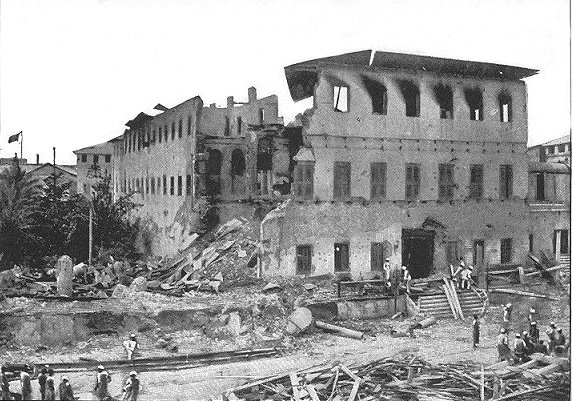
The Anglo Zanzibar War of 1896 is generally considered the shortest war in recorded history. The actual fighting lasted about 38 minutes, beginning at roughly 9:02 a.m. and ending around 9:40 a.m. on August 27, 1896.
The war was fought between the British Empire and the Sultanate of Zanzibar. It began over a dispute about who should become Zanzibar’s next Sultan. Britain had already gained strong political control over Zanzibar, and the new Sultan, Khalid bin Barghash, was unwilling to accept British demands simply.
How Did The War Begin
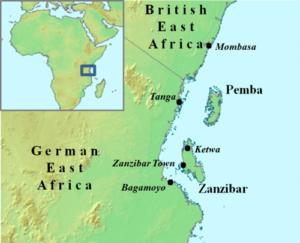
Zanzibar was an important trading center on the East African coast during the 19th century. Today, Zanzibar is a semi-autonomous part of Tanzania, located in the Indian Ocean off the coast of mainland Tanzania.
The immediate crisis came on August 25, 1896, when Sultan Hamad bin Thuwaini died suddenly. His nephew, Khalid bin Barghash, moved into the palace and declared himself the new Sultan. The British authorities did not recognize him and instead supported Hamoud bin Mohammed, who was considered more acceptable to British interests.
Khalid had already shown that he was willing to challenge British interference in Zanzibar’s politics. His decision to take the palace without British approval therefore looked like a direct challenge to Britain’s authority. He gathered supporters around the palace and prepared to defend his claim rather than step aside.
Britain Demands Khalid to Surrender
Their representative in Zanzibar, Basil Cave, demanded that Khalid leave the palace and give up his claim to the throne. British warships were already gathering in the harbor, making it clear that the demand was backed by military force.
Khalid refused to surrender.
By the morning of August 27, around 2,800 men had gathered around the palace to support him. They had rifles and several artillery pieces, while Khalid’s royal yacht, the HHS Glasgow, was also prepared to resist the British fleet. From Khalid’s point of view, he had a sizeable force protecting the palace. The problem was that the British had far more powerful weapons.
The British gave Khalid until 9:00 a.m. to leave. When the deadline passed, there was still no surrender. Five Royal Navy ships were positioned in the harbor, ready to attack.
Britain Attacks the Sultan’s Palace
At around 9:02 a.m., British ships opened fire on the palace and nearby defensive positions. The attack was not a small exchange of gunfire. Heavy naval guns began striking the palace complex, while British forces also targeted Khalid’s artillery and other positions around the harbor.
The difference in firepower quickly became obvious. Khalid’s men could fire back, but they were defending a fixed position against modern British warships. The palace was hit repeatedly and soon caught fire. The bombardment also damaged other buildings and caused heavy casualties among the people gathered around the palace.
Khalid’s royal yacht, the HHS Glasgow, attempted to engage the British ships. It was quickly overwhelmed and sunk. By this point, it was becoming clear that Khalid’s forces could not continue the fight for long.
How the War Came to an End
The bombardment continued for less than an hour. At approximately 9:40 a.m., a white flag was raised and the fighting stopped. The palace had suffered extensive damage, and Khalid’s forces had been defeated. Using the commonly cited times, the conflict had lasted about 38 minutes.
Khalid himself had escaped from the palace during the attack. He eventually reached the German consulate, where he was given protection. The British wanted him arrested, but German authorities helped him leave Zanzibar and reach German East Africa, which is now part of Tanzania.
With Khalid gone, the British installed their preferred candidate, Hamoud bin Mohammed, as Sultan. The political dispute was therefore settled almost as quickly as the military one. Britain had achieved what it wanted without needing a long campaign or occupation.
How Many People Died?
More than 500 people on the Zanzibari side were killed, according to historical accounts. The casualties included Khalid’s supporters and people caught in the palace area during the bombardment.
British losses were extremely small by comparison. Historical accounts record one British marine being wounded, with no British deaths reported during the fighting.
The difference in casualties was largely the result of Britain’s military advantage. Its warships could attack the palace from the harbor with powerful artillery, while Khalid’s forces had little ability to seriously damage the British fleet.
Why Was the War So Short?
The short duration was mainly a result of the enormous difference between the two sides’ military capabilities.
Khalid had more soldiers around the palace than the British had troops immediately available on land, but that did not give him the advantage. His men were concentrated in and around the palace, making them an easy target for naval artillery. The British could attack from the water without having to fight their way through Zanzibar’s streets first.
There was also no reason for Britain to keep fighting once Khalid’s position collapsed. The British objective was to remove him and install a ruler they supported, not to conquer a large enemy army. Once the palace was destroyed and resistance ended, the conflict was effectively over.
Was It Really Exactly 38 Minutes?
The 38 minute figure is the most commonly quoted duration, but historians do not all give exactly the same number. The Historical Association, for example, notes that sources have described the bombardment as lasting 38, 40 or 43 minutes.
That does not mean the famous record is false. It simply means that historical events were not always recorded with the kind of precise timing we expect today. The exact moment when the first shot was fired and the exact moment when the fighting was considered finished can vary between accounts.
So, the safest description is that the Anglo Zanzibar War lasted about 38 minutes and certainly less than an hour. It remains widely recognized as the shortest war in recorded history.
What Happened After the War
Although the fighting ended in minutes, its political consequences lasted for decades.
Hamoud bin Mohammed became Sultan with British backing, and British influence over Zanzibar became even stronger. The war demonstrated that the Sultan could not make major political decisions without considering British interests. Zanzibar remained a sultanate, but its independence was increasingly limited by the British protectorate system.
The conflict also took place during a period of intense European expansion in Africa. Britain and Germany were competing for influence in East Africa, while Zanzibar itself had long been an important center of trade and political power along the coast.
