

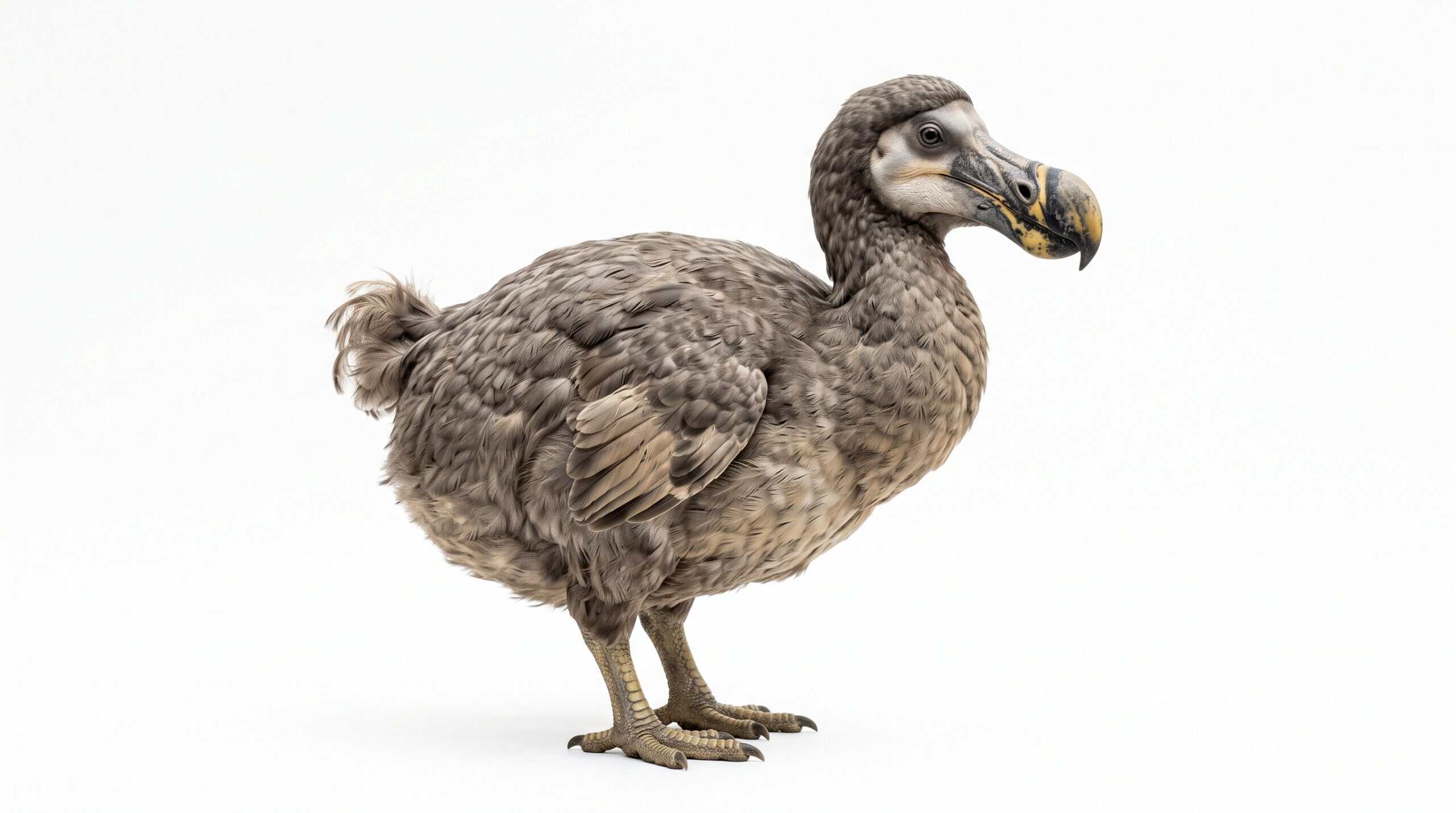
The dodo was not simply a “dumb” bird that disappeared because it was too slow or too stupid to survive. It was a large, flightless pigeon that evolved for life on the isolated island of Mauritius, where it faced few natural threats. Scientists now have evidence that its brain was about the size expected for a bird of its body size, and its extinction was largely connected to the sudden changes humans brought to its island home.
What Was the Dodo Bird?

The dodo, scientifically known as Raphus cucullatus, was a flightless bird found only on Mauritius, an island in the Indian Ocean east of Madagascar. It belonged to the pigeon and dove family, although its large body made it look very different from the pigeons we see today. Its closest living relative is the Nicobar pigeon.
Scientists estimate that an adult dodo weighed around 12 kilograms on average, although individual body weights probably varied considerably. That made it several times heavier than the largest living pigeons and doves.
The dodo had a large hooked beak, strong legs, small wings and a relatively large body. However, many famous paintings of fat, round dodos may give us an inaccurate idea of its actual appearance. Historical illustrations were often based on captive or poorly observed birds, and some artists exaggerated their size and shape.
Why Couldn’t the Dodo Fly?
The dodo lost the ability to fly through evolution. Over many generations, birds living on Mauritius faced very different conditions from birds living on continents.
Mauritius had no native land mammals capable of hunting adult dodos. With fewer predators to escape from, flying became less important for survival. Energy that would otherwise support powerful flight muscles and wings could instead support a larger body and other adaptations useful for life on the ground.
This is a common pattern on isolated islands. Birds can evolve toward flightlessness when flying provides little advantage and maintaining flight ability becomes less useful. The dodo was not “broken” because it could not fly. It was adapted to the environment in which it evolved.
What Did the Dodo Eat?
Scientists do not know the dodo’s complete diet with certainty because nobody performed detailed biological observations while the species was alive. However, evidence from its anatomy, historical accounts and its ecosystem suggests that it probably ate a variety of plant foods, including fruits and seeds. It may also have had a more flexible diet than the old image of a simple fruit eater suggests.
The dodo also had a muscular digestive system suited to processing tough foods. Historical descriptions mention stones inside its gizzard. Birds commonly swallow stones because they help grind food inside this muscular part of the digestive system.
One interesting detail concerns the forests of Mauritius. The dodo was one of the island’s larger fruit-eating animals, so its disappearance may have changed how some plants dispersed their seeds. However, the popular claim that a particular Mauritian tree depended entirely on the dodo to reproduce is much more complicated than often presented and should not be treated as a fact.
Was the Dodo Really a Dumb Bird?
The idea that dodos were stupid largely comes from their behavior around humans. Early visitors reportedly found some dodos relatively tame and easy to approach. To modern people, an animal that does not run away from hunters can look unintelligent. But this interpretation is misleading.
The dodo had evolved on an island where it had little reason to fear humans or other large land predators. Its lack of fear was therefore more likely a consequence of its evolutionary history than evidence of poor intelligence. An animal does not need to recognize humans as dangerous if humans have never existed in its environment before.
More importantly, researchers have examined the dodo’s brain by creating detailed internal models of its skull. A 2016 study found that its brain size was approximately what would be expected for a bird of its body size. The researchers concluded that its intelligence may have been broadly comparable to that of pigeons. [1]
That does not prove that dodos were highly intelligent, because intelligence cannot be measured from brain size alone. However, there is also no good scientific evidence that the dodo was exceptionally stupid. In fact, research published in 2026 found unusual features in the dodo’s sensory anatomy, including indications that its sense of smell may have been relatively well developed. This could have helped it locate food and navigate its environment. [2]
How Did the Dodo Live?
Much of the dodo’s behavior remains uncertain because Europeans encountered the species only during the final part of its existence. Early accounts are often incomplete or contradictory, making it difficult to separate reliable observations from later stories.
Bone research has revealed some fascinating details. A study of dodo bone tissue suggests that the birds probably bred around August and that young birds grew rapidly. This would have allowed chicks to become strong before Mauritius entered its summer cyclone season. Adults appear to have molted after the breeding period. [3]
Each female probably produced a single egg rather than a large clutch. This reproductive pattern would have made the population particularly vulnerable when predators began reaching their nests and young.
The dodo was also a ground-dwelling bird. Its strong legs and large body were useful for moving around its island habitat, while its wings had become too small for normal flight. Some evidence suggests that males may have defended territories and used their large bills in fights.
Why Did the Dodo Become Extinct?
Portuguese sailors reached Mauritius in the early 16th century, followed later by Dutch settlement. Humans brought animals that had never naturally existed on the island, including pigs, rats, dogs, cats and other introduced species. These animals changed the ecosystem and created new threats to species that had evolved without such predators.
Pigs and rats were especially dangerous because they could destroy nests and eat eggs or young birds. Other introduced animals competed for food or damaged vegetation. At the same time, human settlement caused habitat changes and directly affected dodos through hunting and disturbance.
The last confirmed sighting of dodo occurred in 1662, but later evidence suggests that some dodos may have survived for several decades afterward. One statistical study estimated extinction around 1690, while later historical analysis produced a similar estimate.
What Happened to the Dodo Remains?
Although the dodo disappeared centuries ago, scientists can still study it through bones, preserved specimens, historical descriptions and modern imaging techniques.
The famous Oxford Dodo is one of the most important surviving remains. Only a small number of physical dodo specimens from the period when the species was alive survive today, making every remaining bone especially valuable. Fossil and subfossil discoveries in Mauritius have also helped researchers understand its anatomy, growth and environment. [4]
Modern technology has changed what scientists can learn from these remains. CT scanning can reveal the internal structure of skulls without destroying them, while bone analysis can provide information about growth and reproduction. Genetic research has also recovered dodo DNA from preserved remains, although having DNA does not mean that scientists can simply clone an extinct dodo.
Can Scientists Bring Back the Dodo?
Not currently. Scientists have recovered and studied dodo DNA, but having DNA is very different from having enough complete, usable genetic material to recreate an identical living dodo.
There is research into de-extinction, which uses genetic engineering to modify the DNA of a living relative so that it develops some characteristics of an extinct species. However, even if scientists eventually create a bird with many dodo-like characteristics, it would not necessarily be a genetically identical dodo.
Refereneces
[1] Gold, M. E., et al. Research on dodo brain anatomy and intelligence, discussed by the American Museum of Natural History. Dodos Were Smart. Link
[2] The sensory world of the Dodo and Solitaire revealed by endocast and skull anatomy. Zoological Journal of the Linnean Society, 2026. Link
[3] Bone histology sheds new light on the ecology of the dodo (Raphus cucullatus, Aves, Columbiformes). Scientific Reports, 2017. Link
[4] Oxford University Museum of Natural History. The Oxford Dodo. Link
